Butiama Bed & Breakfast

Butiama Bed & Breakfast
Showing posts with label people. Show all posts

Thursday, 1 December 2016

Le travels to the Great Barrier Reef

I climbed Mt. Kilimanjaro with Le Huynh in August 2008. He travels the world, and shares images and experiences of the places he visits. He shares the following stunning photos and a poem from his recent visit to the Great Barrier Reef off Australia.


He writes of his experience:

Dear friends

We come from the sea
we bleed salty blood
we cry salty tears
we're humble at sea.

Some may say that
there's nothing to see...
only the same sky
above the same sea!

Oh what a canvas
of infinite colors
forever changing light
open your eyes to see!

Le
Great Barrier Reef 2016

Thursday, 14 March 2013

Antoni Folkers visits Butiama

Dutch architect and urban designer, Antoni Folkers, is visiting Butiama District for a few days at the invitation of Musoma Urban member of parliament, Hon. Nimrod Mkono.
Antoni Folkers. Photo courtesy of African Architecture Matters.
Hon. Mkono has asked Mr. Folkers to provide urban design plans for the newly gazetted district of Butiama. He is a director and the senior designer for the architectural firm FBW Architects that has offices in Manchester, Dar es Salaam, Utrecht, and Kampala.

He is the author of Modern Architecture in Africa and is the holder of a Masters in Architecture from Delft University of Technology. More details on his academic and professional experience can be found here.

During his visit he was accompanied by Swantje Scheunemann, Corporate Social Responsibility Manager of Mkono & Co Advocates.

Wednesday, 13 March 2013

Excuse me, do I know you?

I will admit at the outset that I am better at remembering faces than names. This morning I embarrassed myself for yet another time after I approached a middle aged man at Mwanza Hotel and told him he looked familiar.

He remained quiet but he looked at me with an intense stare that exuded authority and I said: "Have you visited Butiama before?"

He relaxed slightly and told me Butiama is a famous national location and - I interjected: "Then I probably met you at Butiama."

He said: "I am Brigadier-general Balele." As I said earlier I remember faces better than I remember names. But now I understood very well why he exuded near absolute authority when he stared at me. You cannot command soldiers without possessing an aura of authority.

Brig. Gen. Balele is the former regional commissioner for Shinyanga region and I, as someone who reads news reports quite regularly, should have effortlessly matched his name to the familiar face I thought I had seen at Butiama.

As he sat having breakfast a distance from my table I googled his name. Some of the results, given my experience so far this morning, could be rightly described as miraculous. One social networking website had announced his death on 1st March 2011. Someone was lying.

I concluded that the social newtworking site had concocted one of the more memorable lies of 2011. Confronting that stare again to question his existence was out of the question.

Tuesday, 12 February 2013

Le's travels: Mayotte


Kilimanjaro Club member Le Huynh, a native of Vietnam, is a globetrotter and has traveled to the farthest corners of Earth. He normally sends reports of his travels, this time from the French island territory of Mayotte.
******************************************************** 
Dear friends,
For centuries, during the Age of Empire, the ancient Arab traders have long taken advantage of the katabatic wind, also known as the Trade wind, which blows from the Northeast in the Northern Hemisphere to cross the world's oceans in search of new economic opportunities. The Arab merchants have sailed along the East African coast and established many trading outposts for ivory, spices and (regretfully) slaves. The islands of Zanzibar were among the most famous throughout this period of Arab expansion.
Maki (local name): an endemic Lemur of Mayotte island
 A few even more daring Arab captains have continued southward and eventually landed on the Comoro islands,a group of islands in the Mozambique Channel in the Indian Ocean, about 300km North of Madagascar. Eventually,a system of prosperous city-states began to flourish under the rule of powerful Sultans who also brought with them Islam. One of these islands is the island of Mayotte.
The beaches in Mayotte are often lined with Baobab trees
For better or worse, the last Sultan Adriansouli, in order to seek protection from numerous enemies he made during the rise of his power, decided to form an accord ceding the island to France making Mayotte a French colony. Even more interesting, when the rest of the Comoro islands announced their independence, a large majority of Mayotte population voted to stay with France. It became an overseas department of France in March 2011.

So why go to Mayotte in the first place? Well, the most compelling reason is that tourists are almost non existent there :-) Those dashing few that deserted the well-trodden path of Madagascar are rewarded to be left alone on their quest of authentic flavors! This is nature at its unspoiled state with all its rough edges and wild life, especially a coral reef lagoon that can rival the best of any reef system in the world for its quality of pristine ecosystems.

Mayotte deserves to be on the list of UNESCO world heritage sites but then again, but I prefer not because if it ever happens, the tourists would be coming...

Le
Mayotte 2012

Posts related to this one:
http://madarakanyerere.blogspot.com/2010/03/les-despatches.html
http://madarakanyerere.blogspot.com/2012/05/kilimanjaro-club-member-le-huynh-native.html
http://madarakanyerere.blogspot.com/2010/10/pose-with-crocodile-i-pass.html

Thursday, 24 January 2013

Musician Abdul Salvador is visiting Norway

Tanzanian musician and owner of Hisia Sounds Band, Abdul Salvador, is on a private visit to Norway since 10th January 2013 at the invitation of the owners of Bomani Beach Bungalows, located near Bagamoyo, where he performs regularly.

I haven't asked, but knowing how hot it is in Dar es Salaam (where he lives) and comparing that with the amount of snow I see in the photos he has sent, I believe he'd rather be indoors behind his keyboard than outdoors in the cold.


Actually, he does confirm my suspicions with an entry on his website where he reports he experienced temperatures of -16 Celcius. Now, that's cold for anyone who who travels from Tanzania's tropical conditions.
In Oslo he performed at the Bomani Beach Bungalow booth at the Travel Fair, from 11th to 13th January 2013, and attracted great interest from visitors.

He also plans to visit local bands in Grimstad.

Post related to this one:
http://madarakanyerere.blogspot.com/2012/10/visitors-to-butiama-asha-and-abdul.html

Monday, 3 December 2012

Even the Pope has a Twitter account? Maybe it's time to reconsider...

Now that it has been revealed that Pope Benedict XVI has a Twitter account, I am thinking perhaps it is an opportune time to consider opening one myself. I actually already have, but I have not used it since I did about two weeks ago.

As a following and compared to how many might 'follow' the Pope, I might not have much to start with but I could start with the handful of readers who visit this blog every day. I will also consider stirring up some controversy to lure followers to my Twitter updates.

I have to admit though I am normally reluctant to hop on the latest social media fad because of the huge amount of time that one has to devote to keeping up with updates. I have an extremely slow Internet connection speed at Butiama and, rather than spend time on social media, I would rather spend my time responding to routine email correspondence related to my current work.

But since some of my work involves writing visiting and commenting on social websites sometimes provides ideas for topics. It's a balancing act that requires devoting time on both activities.

Monday, 12 November 2012

Dr. Thomas Molony's quest to become a Munroist

Dr. Thomas Molony, a regular visitor to Butiama, is on a mission to climb 283 mountains in Scotland. He has climbed 28 already. Known as the Munros, these are mountains of a height of more than 914.4m above sea level. A comprehensive description of the Munros is found here.
Thomas Molony at the top of a mountain somewhere in Scotland.
While the heights of these mountains are relatively modest they pose considerable challenges to mountaineers, because of exposure to Atlantic and Arctic weather systems.
The attempt to climb all the Munros is called "Munro bagging" and one who accomplishes this task is called a Munroist. I have asked Dr. Molony to keep me abreast of his future Munro climbs and will be looking forward to addressing introducing him to fellow mountaineers as "Munroist Dr. Thomas Molony."

Dr. Molony is Senior Research Fellow at the Centre of African Studies of the University of Edinburgh. He is also putting final touches to a biography on the late Mwalimu Julius Kambarage Nyerere.

Posts related to this one:
http://madarakanyerere.blogspot.com/2011/07/visitors-to-butiama-dr-thomas-molony.html
http://madarakanyerere.blogspot.com/2012/07/my-version-of-year-2011-in-review-3_27.html
http://madarakanyerere.blogspot.com/2011/09/my-version-of-year-2010-in-review-may.html
http://madarakanyerere.blogspot.com/2012/07/my-version-of-year-2011-in-review-27.html
http://madarakanyerere.blogspot.com/2012/07/my-version-of-year-2011-in-review-22.html

Saturday, 10 November 2012

Here's yet another CV update from Prof. Sospeter Muhongo

Early this month, Prof. Sospeter Muhongo was in the United States at the invitation of the Geological Society of America (GSA) for his appointment as Honorary Fellow to the GSA. This updated CV includes the recent addition to his accomplishments and also expands his other contributions in the field of geology and mineral maps.

If you need help writing your CV, you might want to look at author Corinne Mills' top-rated book You're Hired!: How to write a brilliant CV which is available through Amazon.
***************************************
Prof. Sospeter Muhongo, a distinguished scholar, is the Minister of Energy and Minerals of the United Republic of Tanzania and a Nominated Member of Parliament. He is, "Officier, Ordre des Palmes Académiques", an Honorary Fellow of the Geological Society of America (HonFGSA), an Honorary Fellow of the Geological Society of London (HonFGS), an Honorary Research Fellow of the Chinese Academy of Geological Sciences (HonFCAGS), a Fellow of the Academy of Sciences for the Developing World (FTWAS), a Fellow of the Geological Society of Africa (FGSAf), a Fellow of the African Academy of Sciences (FAAS), and a Fellow of Tanzania Academy of Sciences (FTAAS). He is a fellow of ten highly learned professional societies. He is the first recipient (2004) of Prof. Robert Shackleton (UK) Award for Outstanding Research on the Precambrian Geology of Africa. He is the Vice President of the Commission of the Geological Map of the World (CGMW). He is a Full Professor of the University of Dar es Salaam, Tanzania, and an Honorary Professor of Geology at the University of Pretoria, South Africa.

Prof. Muhongo was the Chair of the Jury for the African Union (AU) Kwame Nkrumah Scientific Awards - Continental Awards for Outstanding Scientists 2011 Edition. He is a member of the Executive Board of the African Inter-Parliamentary Forum on Science, Technology and Innovation (AIPF-STI).

Mama Maria Nyerere with
Prof. Dr. Sospeter Muhongo (Officier, Ordre des Palmes Académiques), FGSAf, FAAS, FASI, FASSAf, FTAAS, FGIGE, FTWAS, HonFCAGS, HonFGSA, HonFGS, CGeol, EurGeol
 during his visit to Butiama.
He is effectively involved in various high level regional (Africa) and global science, technology and innovation strategic policy processes (Africa-Europe STI partnerships). He is a Member of the International Experts Group (Global Science Forum) of OECD and has occupied numerous important national, regional, and international professional positions dealing with STI, earth resources, science policy, and science diplomacy. Prof. Muhongo was nominated by his country to be a candidate (2009) for the post of the Director General of UNESCO.

He is Editor-in-Chief of the Journal of African Earth Sciences (Elsevier), Associate Editor of Precambrian Research (Elsevier), and a member of several editorial boards of science journals and bulletins. Prof. Muhongo is the Senior Editor of the published book (2009) on, "Science, Technology and Innovation for Socio-Economic Development: Success Stories from Africa."

Prof. Muhongo was the President of the Geological Society of Africa (1995 - 2001). He was the founding Regional Director (2005 - 2010) of the ICSU Regional Office for Africa, Pretoria, South Africa. He was the Chairperson of the UNESCO-IUGS-IGCP Scientific Board of the International Geoscience Programme (2004 - 2008), and the Chair (2007 - 2010) of the Science Programme Committee (SPC) of the UN-proclaimed International Year of Planet Earth (IYPE). He is a Chartered Geologist and an active member of numerous professional societies including the Geological Society of America, the Geological Society of London, the Royal Commonwealth Society, Geologische Vereinigung (Germany), Geological Society of Africa, Geological Society of South Africa, and the Tanzania Geological Society.

He was the Chairman (1995 - 2005) of the Board of Directors of the State Mining Corporation (STAMICO), Tanzania; and was the Head (1997 - 2000) of the Department of Geology, University of Dar es Salaam. Prof. Muhongo was the Chairman (2002) of the Tanzania Government's Commission of Inquiry on the deadliest Merelani Tanzanite mine's accident.

Prof. Muhongo is mentoring young scientists, engineers, and technologists around the world. He is the Patron of the University of Dar es Salaam Geological Association of Students (UDGAS), a Patron of the National Young Earth Scientists Network (YES, Tanzania), and is an Advisor to the Global Young Earth Scientists Network (YES, Global).

Prof. Muhongo has published over 200 research papers in international journals of high impact factors. He has co-authored widely used geological and mineral maps of Africa, East Africa and Tanzania. He has co-authored widely used geological and mineral maps of Africa, East Africa and Tanzania. He has delivered more than 300 invited keynote speeches around the world at international conferences. He has undertaken over 100 contracted scientific research projects, and consultancy services in the mineral industry, environmental issues and STI policy matters. Prof. Muhongo has been on many STI review/evaluation panels and advisory boards for both national and international institutions and organizations. He has been an External Examiner/Referee for numerous universities, i.e. examinations moderator and academic staff referee/evaluator (e.g. candidates for professorship positions). Over the past two decades, Prof. Muhongo has co-organized over 100 expert group meetings and international earth sciences, STI and science policy conferences, including those on "Science with Africa (Rapporteur-General)" which are hosted by the United Nations Economic Commission for Africa (UNECA), the African Union Commission (AUC) and their partners.

Prof. Muhongo has developed a special interest in the application of STI for sustainable growth and socio-economic development of the global society. Prof. Muhongo, who is the recipient of numerous scholarly and professional awards, recognitions, grants, and fellowships, studied geology at the Universities of Dar es Salaam (Tanzania), and GÓ§ttingen (Germany). He graduated with Dr.rer.nat. degree from the Technical University of Berlin, Germany. Prof. Muhongo is fluent in Kiswahili, English, German and French (basic).

Posts related to this one:
http://madarakanyerere.blogspot.com/2012/09/prof-sospeter-muhongo-gets-more.html
http://madarakanyerere.blogspot.com/2012/05/prof-sospeter-muhongo-and-janet-mbene.html
http://madarakanyerere.blogspot.com/2010/08/prof-sospeter-muhongo-has-returned-to.html
http://madarakanyerere.blogspot.com/2010/09/africa-gets-bad-press-even-in-fiction.html 

Monday, 29 October 2012

Visitors to Butiama: Asha and Abdul Salvador

The easiest path to fame is to have a musician friend.

Many years ago my friend and musician Abdul Salvador and his wife, Asha, visited Butiama and performed a number of live shows with their band, Hisia Sounds. They traveled from Dar es Salaam by bus through Arusha and Nairobi, Kenya, and re-entered Tanzania at the Sirari border post before arriving in Butiama, which is about two hours' drive from Sirari.

On their arrival in Butiama, I recall Salvador's comment, who was traveling to northern Tanzania for the first time: "Tanzania is a huge country. Imagine you have to travel through another country to reach parts of this country!"

Those were the days before the Government of Tanzania executed a decision to rebuild and improve the road from Dar es Salaam to Mwanza, particularly the section between Singida and Mwanza. As a consequence bus operators introduced daily bus services between Dar and Mwanza and even up to Musoma. As a further consequence there is no bus company that serves the longer Dar - Nairobi - Musoma/Mwanza route.


For this number, from left to right, the author of this blog, Evaristus Nchia (stage name, "Dokta Nchia"), Asha Sa;vador, and Abdul salvador.
When Hisia sounds performed at what was once the Makuti Bar in Butiama I was one of the chorus singers on stage. I admit that I danced much better than I sang. Many in Butiama still recall with fond memories Hisia Sounds' visit and my brief moment of fame.

Post related to this one:
http://madarakanyerere.blogspot.com/2010/01/my-version-of-year-2009-in-review-may.html

Sunday, 14 October 2012

Mwalimu Nyerere: the person, lifestyle, and personal philosophy


On the ocassion today of Mwalimu Julius Nyerere's 13th death anniversary, I share a few thoughts on Tanzania's founding president, a leader who has not olny left a lasting impression on Tanzania's political landscape but has captivated the attention of admirers and detractors beyond Tanzania.

*************************************************
 

One common thread that unifies the persona of Mwalimu Nyerere was his unwavering devotion to the advancement and welfare of his fellow human beings. He repeatedly drove home this point in his public discourses by saying that the ultimate purpose of all social, economic and political activity must serve to provide benefits to all citizens.

I quote extensively from one of his speeches, delivered at the launch of his the Mwalimu Nyerere Foundation in Dar es Salaam, as the words encapsulates some his most fundamental beliefs:

“There are many good and honest people who believe that those ideas, which in this country are associated with my name are now dead and should be properly buried. You will not be surprised to hear that I disagree! Great ideas do not die so easily; they continue nagging and every human society in history ignores them at its own peril. And I can say this without inhibition or pretended modesty because in a very real sense they are not my ideas. I never invented them. I am simply a believer, like many other believers, in the world and in human history. I believe in the equality and dignity of all human beings, and the duty to serve, their well-being as well as their freedom in a peaceful and co-operative society. I am an ardent believer in the freedom and welfare of the individual. As I speak to you now I am asserting my own individuality, in a sense of community and fellowship with all other human beings wherever they may be. “Binadamu wote ni ndugu zangu”. That was not something that was said lightly. It came from a firm and profound belief in the nature and dignity of the Animal called the Human Being. I repeat: those ideas are not mine; but I am a believer. I have articulated them and will continue to articulate them with passion.”
 
A dedicated proponent of the primacy of the community as the driving force for transforming the welfare of the individual, Mwalimu Nyerere saw in socialism the means to express his beliefs.

That he should favour communal policies rather than policies that focused on the individual could have been a product of his upbringing. His father, Chief Nyerere Burito, was a chief of the small Zanaki ethnic community located south west of Lake Victoria. His mother, Mgaya wa Nyang’ombe, was the fifth of 22 wives of Chief Nyerere’s homestead, where tradition continues to elevate the needs of the community above the interests of the individual. He reportedly came under the influence of the Fabian Society during his studies at Edinburgh University, although it is evident that influence found congruence within his own upbringing.

He believed that the peaceful and long-term survival of humanity depended on the continued promotion and implementation of such policies. What is not shared can be, in the long run, the source of agitation, conflict, and even civil strife.

Throughout his political career and in his personal life he remained committed to the promotion of human equality and dignity, qualities that were ingrained in the Arusha Declaration, the policy framework that he proclaimed in 1967 to introduce a socialist path for his country.

The Declaration emphasized the abolition of exploitation of one individual by another, a reduction of the income gap between the rich and the poor, the establishment of a democratically-elected government, but of fundamental importance, ownership of the country’s natural resources was to remain under the ownership of the people through their government. The Arusha Declaration was anchored on the principle of equality.

The struggle for human equality and dignity was not confined to Tanzania only and even as the country prepared for independence from Britain on 9 December 1961, Mwalimu Nyerere was already looking beyond the country’s borders to the millions of Africans who remained under the domination of Portuguese rule in Angola, Mozambique, Namibia, Cape Verde, and Guinea Bissau and to those under white minority rule in Zimbabwe and South Africa. He believed that his country’s independence should serve as an impetus to those under the shackles of colonialism and white minority rule when he addressed the Tanganyika Legislative Assembly on 22 October 1959 saying: 

"We, the people of Tanganyika, would like to light a candle and put it on top of Mount Kilimanjaro which would shine beyond our borders giving hope where there was despair, love where there was hate and dignity where before there was only humiliation".

While the general thrust for supporting the liberation struggles of African countries came from the Organization of African Unity, Tanzania under Mwalimu Nyerere’s leadership provided crucial moral and material support to the liberation movements.

While Mwalimu continued to vigorously defend action and policy based on his personal beliefs and philosophy, that defense was sometimes tampered by his view on human equality and dignity. At the end of the Tanzania – Uganda war, fought in 1978 –79, rejecting the views of his advisors, he released Libyan prisoners of war without claiming compensation from the Libyan government. Libya had sent troops to fight on Uganda’s side against the Tanzanian army. The dignity of the human being, even one who had fought against Tanzania, remained paramount.

A quality that even his critics have acknowledged was Mwalimu Nyerere’s integrity and his unflinching belief in the duty of a leader to serve those who put their trust in his leadership. He believed it was not enough that a leader should be of the highest integrity but that those surrounding him – family members, friends, colleagues – should also be consistent with that image.

Perhaps even more telling than his own words and the policies he pursued, Mwalimu lived his beliefs. He shunned materialism stating that the amassing of wealth, whether by the state, or by an individual was useless if it did not serve humans. He may possibly have been the lowest paid head of state during his time and, consequently, came close to losing a house built in Dar es Salaam from a bank loan. He failed to keep up with the interest payments and surrendered it to the bank. It was only through the intervention of his successor, President Ali Hassan Mwinyi, that the government paid off the loan and gave him possession of the house.

Authors have often written that he attended church daily, which is testament to a strong spirituality between him and his creator and, yet, a spirituality that did not blind him from recognizing the disadvantages faced by other faiths.

At independence the Church in Tanzania, unlike other religious organizations, had a well-established system of primary and secondary schools. After independence these were promptly nationalized under his administration, allowing Tanzanians of all faiths access to schools that could have remained under the exclusive control of Christians.

His spirituality was centered upon doing well for his fellow humans, a quality that is reflected both in the policies he pursued in his political life and in his personal life; his faith was not limited to Sundays only.

After his retirement in 1985, and in response to a plea from the Moslem cleric of his village, Butiama, Mwalimu Nyerere who, by coincidence was on one of his overseas travels that included a visit to Libya, asked Libyan leader Col. Muammar Ghadaffi to donate money to repair the Butiama mosque. Col. Ghadaffi is reported to have said he had no money for repairing a mosque but had money for building a new one. The donated funds were handed to Mwalimu and applied towards the construction of a large mosque in place of the small, dilapidated one. 

The mere act of seeking the assistance from an individual who had committed arms and men against Tanzania during the Ugandan war suggests that in Mwalimu, issues transcended personalities. The issue arose when Idi Amin ordered Ugandan troops to invade Tanzania; Tanzania, under Mwalimu Nyerere’s leadership, responded by waging a war against Uganda and, in the process, reclaimed its territory and resolved the issue.

When I was approached by the British Broadcasting Corporation in 2009 to participate in a week-long series of broadcasts to mark the 30th anniversary of the war against Uganda, a commemoration that would also include my meeting with Jaffar Amin, one of Amin’s sons, I accepted without hesitation. When Jaffar stepped out of the car and I embraced him in salutation, a stone’s throw from Mwalimu’s final resting place, I was convinced that no minor tremor would be recorded around Mwalimu’s mausoleum.

Mwalimu remained firm when defending Tanzania’s interests and after those interests were protected he found little difficulty in advancing acts of reconciliation to those who threatened these interests.

One cannot distinguish the person, from his personal philosophy, and from his lifestyle because he practiced what he believed in; he did not preach moral principles on the podium and practice the opposite in his private life. There was little to differentiate between Mwalimu, the leader, and the person. The two were fused into one character and that character was founded on his personal beliefs and philosophy.

Monday, 17 September 2012

Anne Stolmar visits Butiama

Anne Stolmar from Germany describes her occupation as a photographer and an artist and explains she has traveled to Tanzania to interview individuals about their most important life goals.


She recently visited Butiama and shared some of her impressions about Butiama. In her own words:

"I am interested in what Mwalimu Julius Nyerere said in his vision...what he thinks about life and what is important. When I first read in a book about his vision that Tanzanians should be able to give help not only to their tribe, to their family, to the country, to the continent, but also to the whole world I liked very much his vision because I am an idealistic person.

I have my ideas and I think it is important to stand up for them in life, to do something about them. So I was impressed with the ideas and whether these ideas could or could not be realized in society.

Because I think now in our times we are sometimes running out of a vision. We had some ideas in the past but they could not be reached so now they are just like left behind. So I came because of the words of your father to Butiama because then I was preparing my project to come to Tanzania and I met Maurice and Benjamin and knew about their movie , I got in touch with them and asked whether I could interview some of the people they interviewed for their [film] project and I thought it would be interesting to interview the son of Julius Nyerere.

And then I got in touch with you and you suggested I come to Butiama and I thought it was a good idea because for my project I decide to travel to different parts of the country, although sometimes it is a bit hard for me because I don't know the environment and it is new.

It's the second time I have been to Tanzania. I think Butiama is a nice and peaceful place just to walk around and enjoy the landscape because its also feels safe for a foreigner to come here because people have appreciation for Mwalimu Julius Nyerere. So if I come here as a foreigner they don't take me so much as a stranger because they know I am coming here for Julius Nyerere, for the memory. They know that Julius Nyerere had a lot of contact with foreigners so I feel safe to come here, and be closer to the people.

When I look here around the landscape I really would enjoy to stay longer, to walk around, to discover."

My version of the year 2012 in review: 13 December

The bedrooms of the Ikoma Wild Camp are characterised by unique decor.
The elevated dining area provides an excellent vantage point for viewing surrounding wild animals below.

I found out today that in the wild, lightning strikes more than once at the same place.
Not content with having stuck in the mud yesterday, our car was bogged down in mud again for the second time in so many days.

As we waited for the rescue truck to arrive from the Camp, the German film crew of Benjamin


Leers and Maurice Housni took out some of their cameras and began to shoot footage for their documentary, The Teacher's Country.

Other posts in this 2011 review series:
http://madarakanyerere.blogspot.com/2012/09/my-version-of-year-2012-in-review-12.html
http://madarakanyerere.blogspot.com/2012/09/my-version-of-year-2011-in-review-18.html

Sunday, 16 September 2012

My version of the year 2012 in review: 12 December

Maurice Housni wrapped up the photo session at the Highview Hotel in Karatu in the lobby of the


hotel. I had one of the best breakfasts at the hotel.

Before we left, we were asked to make our contribution against global warming; each one of us planted a tree.
It is time for Maurice to plant his tree.
Then, with his colleague Benjamin Leers, we began a game drive that took us through the
Zebras on the slopes of  the Ngorongoro Crater.
Wildebeest in the Ngorongoro Crater.
A large Elephant in the Serengeti National Park.
A Zebra in the Ngorongoro Crater made its own crossing in front of our car.
In the Ngongoro Crater a family of Warthogs ran away from an appraching Hyena.
In the Ngorongoro Crate a lioness approached the pride after an unsuccesful hunt.
The other lions looked up, noticed the lioness was approaching empty-handed, and continued with their siesta.

More Wildebeests in the Ngorongoro Crater.
The same Elephant from a different angle.
Ngorongoro Crater and the Serengeti National Park, where we saw most of the animals found in these two World Heritage sites.

There is a wide selection of books on the Ngorongoro and the Serengeti, including:

Ngorongoro Conservation Area (Great Game Parks of Africa) by Daryl Balfour


The only blotch to the day was when a few kilometres before reaching our destination - Zara Tours Ikoma Wild Camp - our car was bogged down in mud.


However, it only took a while before a rescue vehicle arrived from the Camp and we were soon reunited with delicious meals and comfortable accommodation.

Other posts in this 2011 review series:
http://madarakanyerere.blogspot.com/2012/09/my-version-of-year-2011-in-review-11.html
http://madarakanyerere.blogspot.com/2012/09/my-version-of-year-2012-in-review-13.html

Saturday, 15 September 2012

My version of the year 2011 in review: 11 December

A day after completing the Mt. Kilimanjaro climb, I traveled by car with the German film crew of Benjamin Leers and Maurice Housni to Karatu, near the Ngorongoro Crater, where we stayed at the Highview Hotel, operated by Zara Tanzania Adventures.

The hotel is built on a hill and provides guests with a beautiful view of the valley below.


Benjamin and Maurice immediately set up their camera equipment to begin their photo shooting assignment for Zara Tanzania Adventures.


In the hotel lounge, Maurice began taking photos of some of the hotel's employees.


When the session ended the employees crowded around the digital camera to view their images.


Having just spent the past week in subfreezing temperatures in a tent with a sleeping bag on Mt. Kilimanjaro it was a welcome relief to spend quality time on a large comfortable bed.

Other posts in this 2011 review series:
http://madarakanyerere.blogspot.com/2012/09/my-version-of-year-2011-in-review-10.html
http://madarakanyerere.blogspot.com/2012/09/my-version-of-year-2012-in-review-12.html

Wednesday, 12 September 2012

Letter from Butiama: an answer to our prayers

This is one of numerous articles I wrote for the Sunday News (Tanzania) column "Letter from Butiama" between 2005 and 2011. Publication date: 12 March 2006.
****************************************
After a long period without rain, Tanzania and other parts of the African continent are experiencing excessive rainfall.

A few days ago I drove through Nyamikoma village and what I saw prompted me to track down a man affected by the recent rains.

Shepherd Andrea Fransisko, who is a mason, is the religious head of the Lake Zone under the Magu sub district of the New Apostolic Church. He also heads the Nyamikoma church of the same congregation.

When I saw the church he heads partially submerged in rainwater I felt I needed to talk to him. I had this feeling that since Prime Minister Edward Lowassa recently asked religious congregations to pray for rainfall, many heeded his call and I was convinced Shepherd Andrea was one of them.

It appears those prayers were answered and by biblical proportions. Large areas which suffered under drought have now experienced periods of rainfall which have caused flooding and also brought extensive damage to property. In Magu district alone 30 houses are reported to have been swept away by floodwater.

I had many questions lined up for him, all with the basic purpose of finding out whether faith still abounded under such conflicting signals from above. After my first question he told me God's actions cannot be criticized and I was effectively silenced. At least for a while.

I wanted to know if he could reconcile the fact that their prayers were answered in that manner, with his church under one metre of water. The response was predictable, but it would have been interesting to find a man who has decided to abandon religion altogether in frustration and stay with the more predictable occupation of masonry. That is a situation that newspapers love to expose.

But I was still curious enough to ask some not so direct questions.

For that much rain to fall he must have contributed to a lot of praying, I asked him. He told me that throughout the 20 centres under his authority he did lead a lot of prayers to ask for an end to the dry spell. That I was expecting. What I suspected was unexpected was not only the excessive rainfall but also the the floodwater causing part of the church to remain under water.

He told me apart from the flooding of the church some religious texts and church registers were also damaged. The damage resulted from a heavy downpour on February 24.

I planned my interview with an intent of testing Shepherd Andrea's faith in his Creator and came out with the impression that he was not only steadfast in his faith, but he also found some positive aspects to the incident.

This became apparent when I persisted in trying to dig out a weak link in the chain under his leadership when I asked, "Didn't any member of the congregation wonder why the prayers could not have been answered in moderate proportions?"

"No," he said, "they were happy to scrub clean the Church and clear it of the dirt and mud. Besides, now that the rains have come people are busy planting rice and sweet potatoes." I could tell he did not become Shepherd for nothing.

I went out in search of a dent in the faith of a human being but only ended up discovering other weaknesses in humans which have nothing to do with religion. According to Shepherd Andrea, the person who was given the task of constructing the church chose a low-lying area in a floodplain. To compound the situation, the church stands next to the Mwanza - Musoma road whose low bridges are not adequately cleared of debris and prevents a fluid flow of rainwater.

The result is, during excessive rainfall, the road becomes a dam allowing water to accumulate on one side of the road and preventing the water to flow freely to Lake Victoria, and eventually, to the Nile in Egypt where the Egyptians of centuries past suffered enough damage from floods to devise effective mechanisms for managing the heavenly responses to human suffering.

My version of the year 2011 in review: 5 December

On the second day of the Kilimanjaro Uhuru Climb to mark 50 years of Tanzania's independence,
Deo Semiono and Aneth Tillya.
we stopped briefly for a rest and I told John Semiono, left, of Zara Tanzania Adventures and Aneth Tillya from Leopard Tours Arusha, that they will be the most photogenic couple on this climb.

Looking good on a photograph has nothing to do with the ability to reach the summit of Mt. Kilimanjaro. They had both qualities and reached the summit a few days later.
As a group of porters approached Aboubakar Malipula (with back to camera), a cameraman from Clouds TV, took some low angle video footage.

When we resumed the trek towards Shira 2 camp, his colleague from Clouds TV and host of Kambi Popote, Anthony Nugaz, edged his way up the Seven Hills section, the most testing part of the day's trek.

Other posts in this 2011 review series:
http://madarakanyerere.blogspot.com/2012/09/my-version-of-year-2011-in-review-4.html
http://madarakanyerere.blogspot.com/2012/09/my-version-of-year-2011-in-review-6.html

Tuesday, 11 September 2012

My version of the year 2011 in review: 4 December

Early in the morning we assembled for a photo session at Springlands Hotel before embarking on our first day of the Kilimanjaro Uhuru Climb organized jointly by the Tanzania Tourist Board (TTB) and Zara Tanzania Adventures.
Zainab Ansell, third from left, Zara's proprietor, and her sister Remmy Adam, fourth from left, joined staff and some of the climbers to see off the group of twenty-plus climbers that I was leading on this historic climb to mark 50 years of Tanzania's independence.
When we stopped briefly in downtown Moshi, the German film crew of Benjamin Leers, right, and Maurice Housni, second from right, joined Aneth Tillya, second from left, and another unidentified climber for a photograph.
The four made a photogenic quartet and attracted the attention of others who took several additional photos.
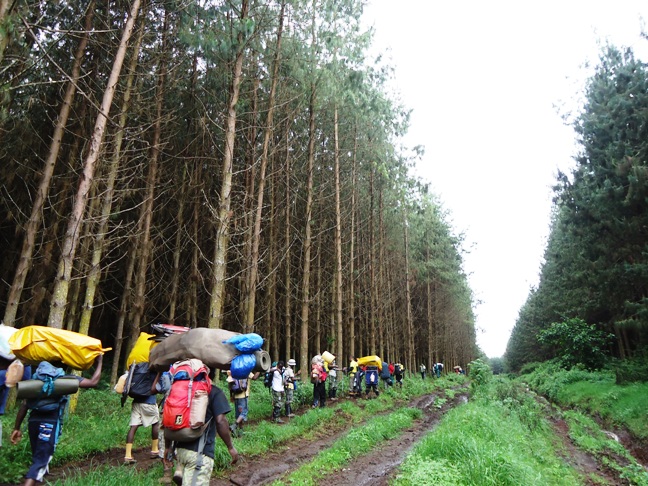
After we registered our names at the Londrossi Gate of the Kilimanjaro National Park we began the 25 minute drive to the edge of the rain forest where the 4-5 hour trek to the first camp, Mti Mkubwa (Big Tree), begins.

Because of the wet road condition, the minibus dropped us some distance before we reached the drop-off point and we were asked to wait to be picked up by an off road truck described by one American climber as "a truck with attitude", a menacing truck that can tackle the worst road conditions. Others decided to begin the walk before the truck's arrival.
The road conditions were so bad that even "the truck with attitude" had to stop some distance before reaching the end of the road and the beginning of the foot path. It would be at least an entire hour of walking before we reached the normal drop-off point.
Some of the porters began to walk ahead of us. My fourth Mt. Kilimanjaro climb, the first time I had attempted to climb Mt. Kilimanjaro twice in a year, was underway.

Other posts in this 2011 review series:
http://madarakanyerere.blogspot.com/2012/09/my-version-of-year-2011-in-review-3.html
http://madarakanyerere.blogspot.com/2012/09/my-version-of-year-2011-in-review-5.html

Monday, 10 September 2012

Prof. Sospeter Muhongo gets more accolades

In addition to the other numerous awards and distinctions that he has to his credit, Prof. Sospeter Muhongo, who is also Tanzania's minister for Energy and Minerals, has received yet another honour in recognition of his outstanding accomplishments in the field of Geology.

He is now also a Fellow of the Geological Society of America (GSA), a recognition bestowed by the GSA on individuals in recognition of their distinguished contributions to the geosciences.

Here  is the latest CV of Prof. Muhongo:

Professor Sospeter Muhongo, is the Minister of Energy and Minerals of the United Republic of Tanzania and  nominated member of parliament. He is, Officier, Ordre des Palmes Academiques, an Honorary Fellow of the Geological Society of America (HonGSA),

********************************************************************************


Prof. Sospeter Muhongo, (Officier, Ordre des Palmes Academiques), FGSAf, FAAS, FASI, FASSAf, FTAAS, FGIGE, FTWAS, HonFCAGS, HonGSA, HonFGS, CGeol, EurGe


**************************************************************************************************
an Honorary Fellow of the Geological Society of London (HonFGS), an Honorary Research Fellow of the Chinese Academy of Geological Sciences (HonFCAGS), a Fellow of the Academy of Sciences for the Developing World (FTWAS), a Fellow of the Geological Society of Africa (FGSAf), a Fellow of the African Academy of Sciences (FAAS), and a Fellow of the Tanzania Academy of Sciences (FTAAS). He is a fellow of ten highly learned professional societies. He is the first recipient (2004) of the Robert Shackleton Award (Outstanding Research on the Precambrian Geology of Africa). He is the Vice President of the Commission of the Geological Map of the World (CGMW). Prof. Muhongo is a Full Professor of Geology at the University of Dar es Salaam, Tanzania, and an Honorary Professor at the University of Pretoria, South Africa.

Prof. Muhongo was the Chair of the Jury of the African Union (AU) Kwame Nkrumah Scientific Awards - Continental Awards for Outstanding Scientists 2011 Edition. He is a member of the Executive Board of the African Inter-Parliamentary Forum on Science, Technology and Innovation (AIPF-STI).

He is effectively involved in various high-level regional (Africa) and global science, technology and innovation strategic policy processes (e.g. Africa-Europe STI partnership). He is a member of the International Experts Group (Global Science Forum) of OECD and has occupied numerous important national, regional and international professional positions dealing with STI, earth resources, science policy and science diplomacy. Prof. Muhongo was nominated by his country to be a candidate (2009) for the post of Director General of UNESCO.

He is Editor-in-Chief of the Journal of African Earth Sciences (Elsevier), Associate Editor of Precambrian Research (Elsevier) and a member of several editorial boards of science journals and bulletins. Prof. Muhongo is the Senior Editor of the published book (2009) on "Science, Technology and Innovation for Socio-Economic Development: Success Stories from Africa."

Prof. Muhongo was the President of the Geological Society of Africa (1995 - 2001). He was the founding Regional Director (2005 - 2010) of the ICSU Regional Office for Africa, Pretoria, South Africa. He was the Chairperson of the UNESCO-IUGS-IGCP Scientific Board of International Geoscience Programme (2004 - 2008), and the Chair (2007 - 2010) of Science Programme Committee (SPC) of the UN-proclaimed International Year of the Planet Earth (IYPE). He is a Chartered Geologist and an active member of numerous professional societies including, the Geological Society of America, the Geological Society of London, the Royal Commonwealth Society, Geologische Vereingung (Germany), Geological Society of Africa, Geological Society of South Africa, and the Tanzania Geological Society.

During a visit to Butiama, Prof. Sospeter Muhongo with Mama Maria Nyerere, left, widow of Tanzania's founding president, Mwalimu Julius K. Nyerere.
He was the Chairman (1999 - 2005) of the Board of Directors of the State Mining Corporation (STAMICO), Tanzania, and was the Head (1997 - 2000) of the Department of Geology, University of Dar es Salaam, Tanzania. Prof. Muhongo was the Chairman (2002) of the Tanzania Government's Commission of Inquiry on the deadliest Mererani Tanzanite mine's accident.

Prof. Muhongo is intensively mentoring young scientists, engineers and technologists around the world. He is the Patron of the University of Dar es Salaam Geological Association of Students (UDGAS), a Patron of the National Young Earth Scientists Network (YES, Tanzania) and is an Advisor to the Global Young Earth Scientists Network (Yes, Global).
_______________________

For those seeking useful advice for writing CVs, Author Midred Talabi offers useful advice in her book 7 Keys to a Winning CV: How to create a CV that gets results.
________________________________

Prof. Muhongo has published over 200 well acknowledged research articles, geological and mineral maps. He has delivered more than 300 invited keynote speeches around the world at international conferences. He has undertaken over 100 contracted scientific research projects, and consultancy services in the mineral industry, environmental issues and STI policy matters. Pro. Muhongo has been on many STI review/evaluation panels and advisory boards for both national and international institutions and organizations. He has been an external Examiner/Referee for numerous universities, i.e. examinations moderator and academic staff referee/evaluator (e.g. candidates for professorship positions). Over the past two decades, Prof. Muhongo has co-organized over 100 expert group meetings and international earth sciences, STI and science policy conferences, including those on "Science with Africa (Rapporteur-General)" which are hosted by the United Nations Economic Commission for Africa (UNECA), the African Union Commission (AUC) and their partners.

Prof. Muhongo has developed a special interest in the application of STI for sutainable growth and socio-economic development of the global society. Prof. Muhongo who is the recipient of numerous scholarly and professional awards, recognitions, grants, and fellowships studied geology at the Universities of Dar es Salaam and GHttingen (Germany). He graduated with Dr.rer.nat. degree from the Technical University of Berlin, Germany. Prof. Muhongo is fluent in Kiswahili, English, German and French (basic).

Posts related to this one:
http://madarakanyerere.blogspot.com/2012/05/curriculum-vitae-of-dr-salim-ahmed.html
http://madarakanyerere.blogspot.com/2010/03/notburga-maskinis-curriculum-vitae.html