The roof is up today for one of the grain silos at Mwitongo, Butiama.
Tilting the roof provides access to the finger millet stored in the silo. The finger millet flour is mixed with cassava or maize flour to cook ugali (hard porridge), a favorite meal among members of the Zanaki ethnic group.
Occasionally, as is the case in this occasion, the roof of the silo is tilted to permit visitors to view the grain stored inside.
Mwitongo is the compound of the residence of Tanzania's founding president, Mwalimu Julius Kambarage Nyerere.
I blog what I observe around me, and I end up writing on a wide range of subjects including cultural tourism, customs and traditions, travel, and mountaineering. Specifically, what happens in and around the village of Butiama, the birthplace and final resting place of Tanzania's founding president, Mwalimu Julius Kambarage Nyerere.
Butiama Bed & Breakfast
Showing posts with label cultural tourism. Show all posts
Thursday, 29 December 2016
Thursday, 9 May 2013
My version of the year 2012 in review: 26 March
Visitors from the mobile operator, Tigo, paid a visit to Butiama from Mwanza.
The Butiama Cultural Tourism Enterprise (BCTE), a community-based organisation that promotes the village of Butiama as one of the tourism destinations under the Cultural Tourism Programme (CTP) supervised by the Tanzania Tourism Board (TTB), receives domestic and foreign visitors to Butiama throughout the year.
For more on the BCTE and its attractions, visit BCTE's Facebook page:
https://www.facebook.com/pages/Butiama-Cultural-Tourism-Enterprise-BCTE/299030663471476?ref=hl
Other posts from the 2012 review series:
http://madarakanyerere.blogspot.com/2013/05/my-version-of-year-2012-in-review-24.html
http://madarakanyerere.blogspot.com/2013/05/my-version-of-year-2012-in-review-7.html
Other posts from the 2012 review series:
http://madarakanyerere.blogspot.com/2013/05/my-version-of-year-2012-in-review-24.html
http://madarakanyerere.blogspot.com/2013/05/my-version-of-year-2012-in-review-7.html
Monday, 29 October 2012
Singida choir members visit Butiama
Members of the St. Cecilia Choir of the Catholic Church in Singida yesterday paid a visit to Butiama and visited the mausoluem of Mwalimu Julius Kambarage Nyerere.
They were winding up their tour of Mara region and were traveling from Musoma to Isenye on their way to Singida through the Serengeti National Park.
Saturday, 28 July 2012
My version of the year 2011 in review: 23 August
Former teacher Lazaro Kinyaki from the village of Nyamuswa near Butiama and now the cultural tourism coordinator for Nyamuswa, leafed through a calendar while visiting the library housing the
collection of books and papers of Mwalimu Julius Kambarage Nyerere, Tanzania's founding president.
Kinyaki brought along trainee tour guides for the day-long trip that included visiting Mwalimu
Nyerere's residence at Mwitongo in the village of Butiama.
Other posts in this 2011 review series:
http://madarakanyerere.blogspot.com/2012/07/my-version-of-year-2011-in-review-3_27.html
http://madarakanyerere.blogspot.com/2012/07/my-version-of-year-2011-in-review-7.html
collection of books and papers of Mwalimu Julius Kambarage Nyerere, Tanzania's founding president.
Kinyaki brought along trainee tour guides for the day-long trip that included visiting Mwalimu
Nyerere's residence at Mwitongo in the village of Butiama.
Other posts in this 2011 review series:
http://madarakanyerere.blogspot.com/2012/07/my-version-of-year-2011-in-review-3_27.html
http://madarakanyerere.blogspot.com/2012/07/my-version-of-year-2011-in-review-7.html
Sunday, 8 July 2012
Inheritance among the Zanaki
Traditionally, it was the nephew who inherited the property of a deceased uncle.
The rationale, a cynical one, was that an individual is certain that, with his nephew, there is certain consanguinity, a fact that is not always certain with the children born of his wife or wives. One assumes that it was taken for granted that the deceased's sister was actually his sister otherwise the inheritance would actually end up with an individual or individuals who were not related to the deceased.
It is a tradition that is dying.
When Chief Nyerere Burito died on 30th March 1942, all his property was inherited with some exceptions. In those days, wives were also inherited. His 22 wives were inherited except for the fifth, Mgaya wa Nyang'ombe, the mother of Tanzania's founding president, Julius Kambarage Nyerere. Mwalimu Nyerere refused that her mother should be inherited and she went to live with her relatives at Muryaza, a village near Butiama.
Posts related to this one:
http://madarakanyerere.blogspot.com/2010/04/zanaki-and-meat.html
http://madarakanyerere.blogspot.com/2011/10/zanaki-culture.html
http://madarakanyerere.blogspot.com/2012/04/zanaki-culture.html
The rationale, a cynical one, was that an individual is certain that, with his nephew, there is certain consanguinity, a fact that is not always certain with the children born of his wife or wives. One assumes that it was taken for granted that the deceased's sister was actually his sister otherwise the inheritance would actually end up with an individual or individuals who were not related to the deceased.
It is a tradition that is dying.
When Chief Nyerere Burito died on 30th March 1942, all his property was inherited with some exceptions. In those days, wives were also inherited. His 22 wives were inherited except for the fifth, Mgaya wa Nyang'ombe, the mother of Tanzania's founding president, Julius Kambarage Nyerere. Mwalimu Nyerere refused that her mother should be inherited and she went to live with her relatives at Muryaza, a village near Butiama.
Posts related to this one:
http://madarakanyerere.blogspot.com/2010/04/zanaki-and-meat.html
http://madarakanyerere.blogspot.com/2011/10/zanaki-culture.html
http://madarakanyerere.blogspot.com/2012/04/zanaki-culture.html
Wednesday, 16 May 2012
The Butiama Cultural Tourism Enterprise has a new guide
Warioba Magige has just joined the tour guiding team at the Butiama Cultural Tourism Enterprise (BCTE) as a trainee guide.
He has completed Form VI and expects to join university at the end of this year.
Since taking this photo, he has received instructions to smile when guiding visitors around the various attractions within the BCTE area.
Posts related to this one:
http://madarakanyerere.blogspot.com/2012/08/my-version-of-year-2011-in-review-22_20.html
http://madarakanyerere.blogspot.com/2011/09/butiama-cultural-tourism-enterprise.html
He has completed Form VI and expects to join university at the end of this year.
Since taking this photo, he has received instructions to smile when guiding visitors around the various attractions within the BCTE area.
Posts related to this one:
http://madarakanyerere.blogspot.com/2012/08/my-version-of-year-2011-in-review-22_20.html
http://madarakanyerere.blogspot.com/2011/09/butiama-cultural-tourism-enterprise.html
Tuesday, 8 May 2012
Visitors to Butiama
The tour guide's narrative to visitors to the Butiama Cultural Tourism Enterprise (BCTE) at the gazebo next to the residence of Mwalimu Julius K. Nyerere says: "This is where Mwalimu Nyerere preferred to spend some of his free time playing bao [a local board game] with his friends from around Butiama village."
Occasionally, a visitor will ask where exactly Mwalimu Nyerere preferred to sit. The guide will respond: "Right at that corner." And, invariably, that is where the visitor will prefer to sit and pose for a photograph. On this occasion the visitor was a secondary school teacher from Nanga secondary School in Igunga, Tabora region, Amon Mwamwenda.
Butima Cultural Tourism Enterprise (BCTE) Facebook page related to this post:
https://www.facebook.com/photo.php?fbid=371831612858047&set=pb.299030663471476.-2207520000.1362163576&type=3&theater
Occasionally, a visitor will ask where exactly Mwalimu Nyerere preferred to sit. The guide will respond: "Right at that corner." And, invariably, that is where the visitor will prefer to sit and pose for a photograph. On this occasion the visitor was a secondary school teacher from Nanga secondary School in Igunga, Tabora region, Amon Mwamwenda.
Butima Cultural Tourism Enterprise (BCTE) Facebook page related to this post:
https://www.facebook.com/photo.php?fbid=371831612858047&set=pb.299030663471476.-2207520000.1362163576&type=3&theater
Monday, 7 May 2012
The Cultural Tourism Program nurtures cultural expressions
The basic purpose of the Cultural Tourism Program (CTP) which is supervised by the Tanzania Tourism Board (TTB) is to encourage tourists to enjoy the rich cultural heritage that Tanzania offers.
Tanzania is not only about Mt. Kilimanjaro, the Serengeti National Park, the Ngorongoro Crater, and Zanzibar (to mention only a few of the stupendous attractions offered by Tanzania). Also on offer is the rich and varied cultural traditions of the more than 120 ethnic groups found in the country.
Butiama participates in the CTP through the Butiama Cultural Tourism Enterprise (BCTE). The people at BCTE, I included, always keep their ears and eyes open for new cultural groups that spring up within BCTE's area.
I recently saw one of these groups in practice, and BCTE expects they will also be performing for BCTE's visitors in the future.
Post related to this one:
http://madarakanyerere.blogspot.com/2012/03/egumba-dance-group-in-action.html
Friday, 4 May 2012
My version of the year 2011 in review: 1 April
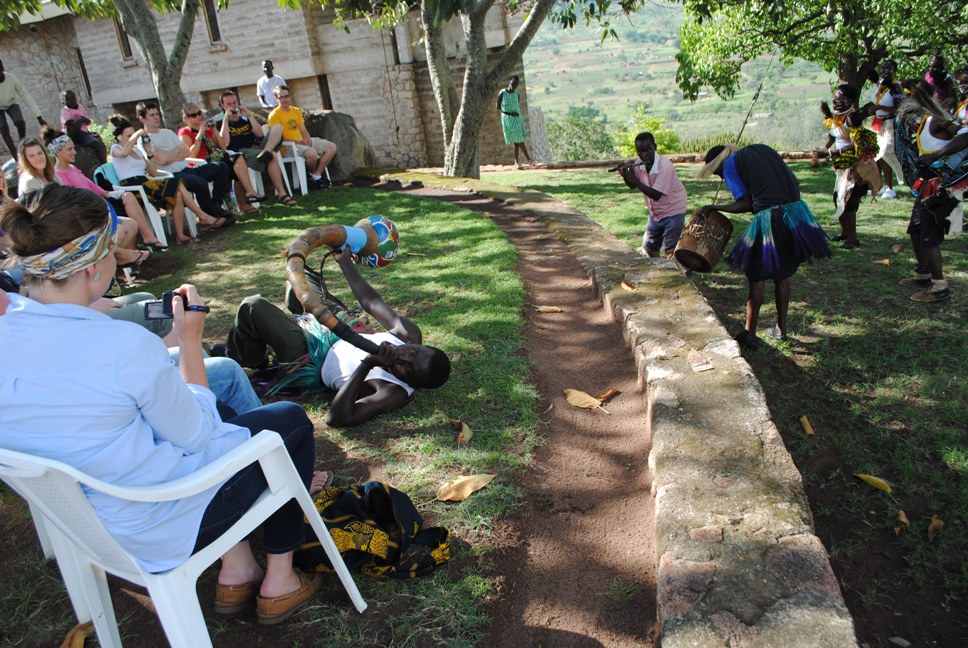
On April Fool's day, there was no fooling around when the Egumba Ngoma group performed for the year's visiting teachers' group from Queen's University in Canada.
In an hour-long performance, the dancers performed a number of traditional dances from the Mara region and from selected regions of Tanzania.
Other posts related to this one:
http://madarakanyerere.blogspot.com/2011/07/egumba-traditional-dancers-perform-at.html
http://madarakanyerere.blogspot.com/2012/03/egumba-dance-group-in-action.html
http://madarakanyerere.blogspot.com/2009/01/visitors-to-butiama.html
In an hour-long performance, the dancers performed a number of traditional dances from the Mara region and from selected regions of Tanzania.
Other posts related to this one:
http://madarakanyerere.blogspot.com/2011/07/egumba-traditional-dancers-perform-at.html
http://madarakanyerere.blogspot.com/2012/03/egumba-dance-group-in-action.html
http://madarakanyerere.blogspot.com/2009/01/visitors-to-butiama.html
Thursday, 3 May 2012
At Butiama we play bao, the board game
Not just the residents, even the visitors play bao. Bao is a popular board game that is widely played in countries of East and Central Africa, including Tanzania.
Susan, left, plays bao against Alisha, partly seen on the right, as Caroline watches. The game has a variation of rules. During their recent stay in Butiama, the Canadian visitors, learnt to play bao under the Zanaki rules of the Zanaki ethnic group.
For more information on bao under Swahili rules, visit: http://en.wikipedia.org/wiki/Bao_%28mancala_game%29
Susan, left, plays bao against Alisha, partly seen on the right, as Caroline watches. The game has a variation of rules. During their recent stay in Butiama, the Canadian visitors, learnt to play bao under the Zanaki rules of the Zanaki ethnic group.
For more information on bao under Swahili rules, visit: http://en.wikipedia.org/wiki/Bao_%28mancala_game%29
Friday, 27 April 2012
My version of the year 2011 in review: 27 March
I went trekking to Mtuzu Hill with this year's teachers from Queen's University in Canada.
Karrie, left, and Alex, right, enacted a scene from the movie, The Titanic. Well, almost.
Then Karrie took a photo of a group of children and showed the image to them.
Sunday, 22 April 2012
Back to base
Having completed the Cross Learning Visit organized by the Cultural Tourism Coordinator of the Cultural Tourism Programme under the Tanzania Tourist Board (TTB), I headed back to Butiama to put into practice at the Butiama Cultural Tourism Enterprise (BCTE) what I had learned from the visit.
I passed through the Ngorongoro Crater, and the Serengeti National Park.
At Seronera in the Serengeti National Park a Marabou Stork stretched out its wings, seemingly readying itself for flight.
Posts related to this one:
http://madarakanyerere.blogspot.com/2011/06/through-serengeti-this-time-from.html
http://madarakanyerere.blogspot.com/2012/09/my-version-of-year-2012-in-review-12.html
I passed through the Ngorongoro Crater, and the Serengeti National Park.
At Seronera in the Serengeti National Park a Marabou Stork stretched out its wings, seemingly readying itself for flight.
Posts related to this one:
http://madarakanyerere.blogspot.com/2011/06/through-serengeti-this-time-from.html
http://madarakanyerere.blogspot.com/2012/09/my-version-of-year-2012-in-review-12.html
Saturday, 21 April 2012
My version of the year 2011 in review: 26 February
On the third day of the Cross Learning Visit to Arusha region organized by the Cultural Tourism Coordinator of the Cultural Tourism Programme under the Tanzania Tourist Board (TTB), we woke up at Longido near the Kenyan border.
When I looked out of the window I saw a mountain in the distance and, as with most people who have climbed mountains, wondered what mountain it was and wondered whether anyone had climbed this mountain. As I continued to observe the mountain's silhouette against the rising sun, I realized I was looking at Mt. Kilimanjaro, which I had already climbed three times. I had never observed Kilimanjaro from this far west and it took a while to recognize some of its familiar features.
On this trip mountains seem to have the effect of influencing group behaviour towards posing for a group photograph. Yesterday, it was Mt. Meru, today we had Mt. Longido as a backdrop. The Longido area, including slopes of Mt. Longido, was part of the battlefields pitting German Imperial forces and the British Army in the East African campaign of World War I.
As we continued our trek for the day our guide, Samwel Mollel, told us: "If you look above the hills, just above the clouds, you will see the snow peak of Mt. Kilimanjaro." It took a little adjustment against the bright morning sun but we managed to just barely make out the outline of the mountain.
We eventually reached our destination: the spot where young Masai warriors meet to go through their rites of passage under the tutelage of those who have advanced to older age groups.
The basic objective of the Cultural Tourism Programme is to enable local communities to earn income from tourism through various services, including the sales of handicrafts to visitors. At the end of the trek we visited a handicrafts market.
When I looked out of the window I saw a mountain in the distance and, as with most people who have climbed mountains, wondered what mountain it was and wondered whether anyone had climbed this mountain. As I continued to observe the mountain's silhouette against the rising sun, I realized I was looking at Mt. Kilimanjaro, which I had already climbed three times. I had never observed Kilimanjaro from this far west and it took a while to recognize some of its familiar features.
On this trip mountains seem to have the effect of influencing group behaviour towards posing for a group photograph. Yesterday, it was Mt. Meru, today we had Mt. Longido as a backdrop. The Longido area, including slopes of Mt. Longido, was part of the battlefields pitting German Imperial forces and the British Army in the East African campaign of World War I.
As we continued our trek for the day our guide, Samwel Mollel, told us: "If you look above the hills, just above the clouds, you will see the snow peak of Mt. Kilimanjaro." It took a little adjustment against the bright morning sun but we managed to just barely make out the outline of the mountain.
We eventually reached our destination: the spot where young Masai warriors meet to go through their rites of passage under the tutelage of those who have advanced to older age groups.
The basic objective of the Cultural Tourism Programme is to enable local communities to earn income from tourism through various services, including the sales of handicrafts to visitors. At the end of the trek we visited a handicrafts market.
Friday, 20 April 2012
My version of the year 2011 in review: 25 February
Continuing with the Cross Learning Visit in Arusha region organized by the Coordinator of the
Tanzania Cultural Tourism Programme of the Tanzania Tourism Board (TTB), we assembled early in the morning near the offices of TTB and, between buildings, caught a glimpse of Mt. Meru.
We then headed for Tengeru to view the attractions and learn about the activities of the Tengeru Cultural Tourism Enterprise (TCTE). On arrival at Tengeru, Mt. Meru, in the background, presented another excuse to take a group photograph.
After receiving a brief history of the TCTE from its founder, Mama Pallangyo. we began a long trek
towards Lake Duluti. The route had displays of various signs with Biblical name places and...
religious slogans, praising the power of the Creator.
Paulina, right, had summoned considerable energy and willpower to walk to the end of the path, negotiating through some difficult sections. Other members of the group had decided to remain behind, exhausted from the long trek. Under a rock shelter we encountered a group in a prayer retreat, one of whom, second right, was Paulina's long lost sister whom she had not seen for years.
On our way back Paulina had to, once again, summon some extra energy to negotiate through some of the steep sections of the trek.
We caught yet another glimpse of Mt. Meru and Lake Duluti.
Having done enough walking for the day, Paulina hopped on a bodaboda (motorcycle taxi) and reduced the day's walking by 5 kilometres.
Tuesday, 17 April 2012
My version of the year 2011 in review: 24 February
As part of a group of cultural tourism stakeholders from Mara region I began the Cross Learning Visit organised by the the Cultural Tourism Coordinator of the Tanzania Tourist Board (TTB) at Mto wa Mbu in Arusha region.
We followed one of the tour itineraries of Mto wa Mbu Cultural Tourism Enterprise (MMCTE), beginning with a visit to ricefields.
The next stop was at the wood carvers' shed. I asked whether they were originally from the area. They actually had relocated from as far away as Mozambique and Mtwara, areas which are known for their wood carving tradition. Rather than wait for the tourists in Dar es Salaam, these carvers had relocated to one of the few towns in Tanzania with a heavy concentration of tourists.
Then we were shown one of the largest cooking pots in existence, used in the preparatory phases of production of the local brew, mbege.
As with the wood carvers, Tingatinga painters have also relocated to Mto wa Mbu.
As we began the last stage of our tour we saw this Peugeot with a heavy load of bananas.

Moments later we walked through banana plantations.
We followed one of the tour itineraries of Mto wa Mbu Cultural Tourism Enterprise (MMCTE), beginning with a visit to ricefields.
The next stop was at the wood carvers' shed. I asked whether they were originally from the area. They actually had relocated from as far away as Mozambique and Mtwara, areas which are known for their wood carving tradition. Rather than wait for the tourists in Dar es Salaam, these carvers had relocated to one of the few towns in Tanzania with a heavy concentration of tourists.
Then we were shown one of the largest cooking pots in existence, used in the preparatory phases of production of the local brew, mbege.
As with the wood carvers, Tingatinga painters have also relocated to Mto wa Mbu.
As we began the last stage of our tour we saw this Peugeot with a heavy load of bananas.
Moments later we walked through banana plantations.
posted from Bloggeroid
Sunday, 1 April 2012
Zanaki culture
One cultural practice of the Zanaki ethnic group that could be considered unusual in other societies is effecting burial on residential compounds.
The photo depicts, on the left, Chief Nyerere Burito's grave. He died on 30th March 1942 and was buried on the grounds in front of his house at Mwitongo in Butiama village.
The round building in the photo was constructed as a memorial on the spot where his house stood.
On the right is the grave of his fifth wife, Christina Mgaya wa Nyang'ombe. She died in 1997 and was estimated to be 105 years old.
Posts related to this one:
http://madarakanyerere.blogspot.com/2009/12/letter-from-butiama-married-life-in.html
http://madarakanyerere.blogspot.com/2010/04/zanaki-and-meat.html
http://madarakanyerere.blogspot.com/2011/10/zanaki-culture.html
http://madarakanyerere.blogspot.com/2012/07/inheritance-among-zanaki.html
Sent from Samsung Mobile
Friday, 30 March 2012
Chief Nyerere Burito's 70th death anniversary
Today is the 70th death anniversary of the death of Chief Nyerere Burito who ruled between 1912 and 1942.
![]() |
| Chief Nyerere Burito, center, with one of his 22 wives on his right and a guard on his left. |
He is the father of Tanzania's founding president, Mwalimu Julius Kambarage Nyerere. Mwalimu's mother, Christina Mgaya wa Nyang'ombe was the fifth of Chief Nyerere Burito's 22 wives.
Posts related to this one:
http://madarakanyerere.blogspot.com/2011/10/zanaki-culture.html
http://madarakanyerere.blogspot.com/2009/06/letter-from-butiama-one-big-family.html
http://madarakanyerere.blogspot.com/2012/04/zanaki-culture.html
Sunday, 25 March 2012
Egumba dance group in action
Thursday, 15 September 2011
Profile: Susan Daudi
Susan Daudi is the fourth of the
students in the Bachelor of Science Program of the University of
Sokoine on her field attachment to the Butiama Cultural Tourism
Enterprise (BCTE). She has completed her studies and will graduate
soon.
With her other three colleagues, she is currently working as a tour guide until the end of September 2011.
Ever since she went on a school trip to
the Mikumi National Park while studying in secondary school in
Morogoro, she has remained interested in tourism and wildlife.
She observes that for most Tanzanians
only a visit to a national park to view wildlife is considered
tourism. Cultural tourism as a concept has yet to catch on among
Tanzanians. “There are some visitors who arrive here and do not
even understand why they are here,” she says.
She sees herself as following a career
in tourism and perhaps with additional training she believes she
might even identify a cultural tourism attraction and launch a
Cultural Tourism Enterprise following the guidelines of the Tanzania
Cultural Tourism program.
Why should anyone visit Butiama? It is
easily accessible, she says. “For example, now that the new
district headquarters will be at Kiabakari, it is possible for
someone visiting the district to also visit Butiama.”
Posts related to this one:
http://madarakanyerere.blogspot.com/2011/09/profile-thomas-itembe.html
http://madarakanyerere.blogspot.com/2011/09/profile-egidia-justinian.html
http://madarakanyerere.blogspot.com/2011/09/profile-mwenda-sanat-mtaki.html
Posts related to this one:
http://madarakanyerere.blogspot.com/2011/09/profile-thomas-itembe.html
http://madarakanyerere.blogspot.com/2011/09/profile-egidia-justinian.html
http://madarakanyerere.blogspot.com/2011/09/profile-mwenda-sanat-mtaki.html
Monday, 12 September 2011
Profile: Egidia Justinian
Egidia Justinian, 24, is the third of four students who are at the Butiama Cultural Tourism Enterprise (BCTE) for their field attachment from the Sokoine University of Agriculture (SUA). She is a second-year student in the Bachelor of Science in Tourism Management, learning tour guiding skills through the BCTE.
“I have had great interest in discovering the tourist attractions that are in our country.” She decided that one of the ways she would be able to discover these treasures was to enroll in the university program and work in a tourism-related field.
She says in high school she had three preferences of study: tourism, teacher training, and law and was eventually selected to study tourism.
What are her impressions of Butiama? She feels the Tanzania Tourist Board should sensitize the local communities on the concept behind cultural tourism to ensure smooth operations when a cultural tourism enterprise is launched in a particular area.
“It is after the residents within the communities understand the concept behind cultural tourism that the enterprise should be launched, because we face various challenges with residents complaining that they are used to visiting this area without paying entrance fees.”
She has advice for other young Tanzanians. “Because tourism is an expanding sector, I advise the youth to study tourism, and one important thing is they should learn various languages. Not just English, even French and Spanish.”
She has plans to work in a national park, or if that is not possible, she prefers to work in a cultural tourism enterprise.
Why should anyone visit the BCTE? She says Butiama has an attractive environment; the visitor will learn about the various activities that Mwalimu [Nyerere] has done; will visit the Mwalimu J.K. Nyerere Museum; the visitor will see where Mwalimu was born, and will also learn about the Zanaki, Mwalimu's ethnic group.
“The other important reason for visiting Butiama is to visit Mwalimu's mausoleum because some visitors believe there is a switch that once turned on allows visitors to see his remains. They should come and see for themselves instead of listening to rumors. I even had students today who asked me the same question,” she concludes.
Posts related to this one:
http://madarakanyerere.blogspot.com/2011/09/profile-thomas-itembe.html
http://madarakanyerere.blogspot.com/2011/09/profile-mwenda-sanat-mtaki.html
http://madarakanyerere.blogspot.com/2011/09/profile-susan-daudi.html
Posts related to this one:
http://madarakanyerere.blogspot.com/2011/09/profile-thomas-itembe.html
http://madarakanyerere.blogspot.com/2011/09/profile-mwenda-sanat-mtaki.html
http://madarakanyerere.blogspot.com/2011/09/profile-susan-daudi.html
Subscribe to:
Posts (Atom)

+(640x480).jpg)
.jpg)


\