Butiama Bed & Breakfast

Monday, 8 December 2014
2013 in review: 3 April
During what was described as the severest winter Europe had experienced in a long time, I flew
back to Dar es Salaam and saw from above what a severe winter looks like: stunnungly beautiful.


Sunday, 7 December 2014
2013 in review: 26 March
In the evening I was in Leuven, Belgium, at the Afrika Filmfestival, an annual celebration of films and documentaries made on Africa and, mostly, by Africans.
This year’s festival also featured two films on Tanzania’s founding president, Mwalimu Julius Kambarage Nyerere (1922 – 1999). One of those films is The Teacher’s Country, a film by Benjamin Leers and Maurice Houcni, which is a reflection by five Tanzanians on 50 years of Tanzania’s independence.
I was one of the five featured in the film, which was also shot during one of my Mt. Kilimanjaro climbs. Both Benjamin and Maurice joined me on that climb.
Among the awardees at the festival was Imruh Bakari, lecturer at the University of Winchester, who received a Lifetime Achievement Award.
 |
| Photo credit: Lilian Nabora. |
 |
| Host Dr. Pendo Maro, left, and the Tanzanian Ambassador in Belgium, Dr. Deodorus Kamala, at the Afrika Filmfestival. Photo credit: Lilian Nabora. |
 |
| I, right, had the honour of presenting Imruh Bakari's Lifetime Achievement Award. Photo credit: Afrika Filmfestival. |
Friday, 28 November 2014
Letter from Butiama: The origin of language
This is one of numerous articles I wrote for the Sunday News
(Tanzania) column "Letter from Butiama" between 2005 and 2011. Publication
date: 11th February 2007.
*************************************************
There is a Biblical passage about the tower of Babel (Genesis11: 1-9) which reports that humans once had a single language, and that we agreed to build a tower to reach heaven. The Almighty God was monitoring the scheme, and stepped in to intervene after deciding we had gone too far.
God created languages, making it impossible for those at the construction site to understand and cooperate with each other. Unable to continue, humans dispersed around the earth to indulge in other mischief.
In the scientific study of languages, experts group those languages with similar characteristics in groups. Genetic or typological characteristics are used for the classifications. Genetic classification, in lines similar to the story of Babel, looks for evidence of linkages to a common language, while typological classifications look for similarities in structure.
The study of language assumes that the groups of languages and the families they belong to are derived from a “parent” or “proto-“ language, the mother of all languages. Bantu is one such group from which most of the languages spoken in the eastern, central, and southern African region originate, while the Germanic subfamily is known to have spawned several European languages including English, German, Swedish, Dutch, and Norwegian.
Science has not and will not be able to determine whether all languages originated from one particular language because the available written records are not consistent across all languages and, even when they are available, cover only a fraction of the estimated thousands of years in which human speech has existed.
However, it is instructive to note that, in some languages, there seems to be some trace of the Biblical account on the tower of Babel.
I believe that Swahili and Italian speakers can make a strong religious claim to being one of the first two language offshoots from Babel, and a scientific claim for being two of the world’s earlier proto-languages.
Take the example of the Italian word giu’ whose pronunciation closely resembles that of the Swahili word juu. Giu’ means “down”, juu is “up.” Imagine the confusion created each time the Swahili speaking bricklayer asked the Italian stores clerk for additional bricks to be sent up.
Although these two words have opposite meanings, if you look at them as representing one of two extremes they are strongly connected on a scale of height, and would give some credence to the Biblical account of the Divine intervention to curtail the effectiveness of communication, at least between Italian and Swahili speakers.
To the northern Chinese ma can have three meanings depending on the intonation you use when pronouncing those two letters. On a flat tone it means “mother”, on a falling tone “to curse.” In Italian the same word means “but” and several other meanings associated with that word.
There are several examples of words that has one decent meaning in one language and a different and obscene unprintable meaning in another. Again, a few Italian words that can be used in normal conversation share the reputation of having obscene Swahili meanings.
While some religions preach that we shared a common language in the past, and scientific study points to a shared common origin of languages in language groups, there is a great likelihood that the advances in human knowledge existing today would have changed the story in the Bible.
I have had the chance to observe Chinese technicians working on a Tanzanian construction site. They could not speak a word of neither English nor Swahili. In comparison, the only Chinese word that their coordinator knew was the word for “beer”, which was of little help even if they were constructing a brewery.
In little time a communications system was developed and used. To order more nails, they showed a nail to the coordinator, and wrote down the size and quantity using the number system familiar to any literate Tanzanian. It worked well for most situations. Thanks to easier communication nowadays, when communication completely broke down, they would place a call to an interpreter in China to resolve the matter.
Human knowledge today would have probably changed the story of Babel. Construction would have continued until the tower would have collapsed from its own height, but while construction lasted, religion and science would have found common ground.
Monday, 24 November 2014
This is the best misprint yet
After publishing this post, I found out that the article with the misprint that I reported was edited and the error was rectified. I choose to leave the original post because it was accurate when I posted it.
********************************************************************************
I have just come across what I consider to be the best misprint yet.
The Daily News (Tanzania) has a news report in which President Jakaya Kikwete has sent a message of condolence to Minister of Information, Youth, Culture, and Sports Fenella Mukangara following the death of two journalists: Innocent Munyuku and Baraka Karashani.
The minister was referred to as “the minter of information….” As far as misprints go, this one is a gem. Considering that the Daily News is a government newspaper and falling under the direct responsibility of the minister, one wonders whether it was a genuine mistake or whether it was a sick joke being perpetrated against Minister Mukangara.
In either case, I suspect heads will roll.
Here’s the link to the story: JK mourns Munyuku, Baraka.
********************************************************************************
I have just come across what I consider to be the best misprint yet.
The Daily News (Tanzania) has a news report in which President Jakaya Kikwete has sent a message of condolence to Minister of Information, Youth, Culture, and Sports Fenella Mukangara following the death of two journalists: Innocent Munyuku and Baraka Karashani.
The minister was referred to as “the minter of information….” As far as misprints go, this one is a gem. Considering that the Daily News is a government newspaper and falling under the direct responsibility of the minister, one wonders whether it was a genuine mistake or whether it was a sick joke being perpetrated against Minister Mukangara.
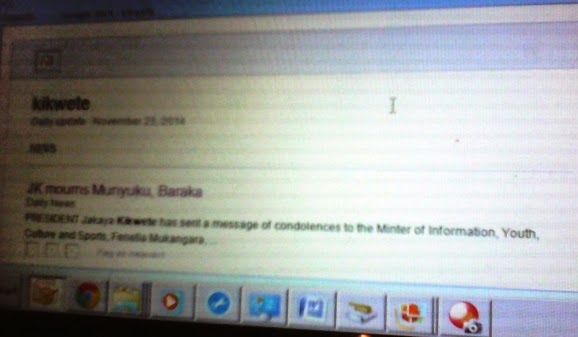 |
| Screen shot of the Google News alert containing the initial error. |
Here’s the link to the story: JK mourns Munyuku, Baraka.
Saturday, 22 November 2014
2013 in review: 25 March
In Belgium I visited the Grand Béguinage of Leuven a UNESCO World Heritage site that consists of buildings built in the 13th century.
 My hosts informed me that the area is sometimes used as a setting for film production.
Subscribe to:
Posts (Atom)